CEDP

CEDP

Wednesday, 13 November 2013

CEDP at Community Energy Scotland Conference!

On the 5th and 6th of November Community Energy Scotland, CES, held their annual conference in Glasgow. The topic of this year's conference was how innovative technology can link local renewable energy generation to local consumption of energy. This topic is of particular relevance for many communities in Scotland where access to the main electricity grid is not possible due to constraints or expensive grid upgrades being necessary.

For many communities in Malawi, looking at off-grid solutions for their energy needs is also common since the national grid only services 9% of the population of Malawi. In this way, communities in rural Scotland have things in common with communities in Malawi. Both are looking for off-grid solutions for their energy needs.

International Development Officer, Sarah Jones, discussing the CEDP with Scottish community groups and proudly wearing her CEDP t-shirt!

A number of Scottish community groups were interested in being informed of the activities of the CEDP and were interested in developing a partnership programme between communities in Malawi and Scotland. Watch this space for more details on the partnership programme!

Tuesday, 12 November 2013

New Issue of Newsletter Published!

                                
To access the second CEDP newsletter go to the Community Energy Scotland website here.

Tuesday, 29 October 2013

CEDP's first batch of cook stoves ready for use!


On November 24th I accompanied CEDP Central Region Officer Blessings Mbendera to carry out the final part of the cook stove production training for Nzona CBO in the district of Dowa. The journey took around 2 hours from Lilongwe and on route we picked up a Social Sciences student from Chancellors College who was keen to find out more about the Community energy sector together with Janet Msiska from Area 55 Consulting who the CEDP in the Central Region has been working together with to carry out the cook stove training programme.

On arrival we were met by an incredibly enthusiastic cook stove producer group who were singing and dancing in celebration. During the day I discovered that the work involved in the production of a clay cook stove took a great deal of commitment and was overwhelmed by the eagerness of the community to make their social enterprise a success! In this blog I will describe the process of clay cook stove production used by this community from clay selection right through to firing.  


Villagers from Nzona CBO in Dowa district surrounding a clay cook stove firing chamber.


Preparing the raw materials

The first stage of cook stove production is to figure where you will get your clay from and decide where your production group will be working from. I discovered that day that extinct ant hills often provide the right quality of soil for producing the cook stoves and after clay analysis from several sites it was discovered that Nzona CBO are fortunate enough to have two sources of clay only ~200m from their production bases.  Given the demand for cook stoves both within the CBO and neighbouring areas it was decided that two production groups be set up in neighbouring villages. Fortunately both are situated close to the clay source.

Despite making it look easy I know that the harvesting of clay is not an easy job. Luckily Blessings has a Nissan pick-up which the community were able to take advantage of to transport the clay from the collection site to where the clay was to be cured. Had we not been there with a vehicle that day I am told that the community would have carried the clay in bags to the production sites.


Members of the energy committee harvesting clay for cook stove production.

In preparation of the clay arriving, a hole had been dug measuring 1m wide x 2m long x 1m deep. Black plastic sheets are then positioned as lining within the hole, the clay is added and covered on top by the sheeting. The purpose of the black plastic sheeting is to act as an impermeable layer so that any living organisms are killed off during the curing process. If this is not done the quality of the clay will be poor and the stoves are likely to crack during the firing process.

Hole being dug which will be lined with black plastic sheeting for curing process.

The process of curing takes 14 days. During the process once every three days water (40 litres approx) is added and mixed in with the clay so that by the end of the curing process the clay is malleable enough to shape into stoves.


Taking shape

Some groups shape the clay stoves by hand, however the approach this community has taken is to use a pedal mould to create standard ‘Chitetezo’ stoves (Chitetezo in Chichewa means Protection). The uptake and roll out of Chitetezo stoves is also being encouraged by the Government of Malawi and the cost of a pedal mould is in the region of 50,000 MK (£100).

A pedal mould for making Chitetezo stoves. The mould comprises of three separate parts, base, cup and pedal.

Once the general shape of the stove has been moulded it its taken out of the mould and a hole is cut at the base which will allow an entry point for fuel. The holes are purposefully kept on the smaller side to encourage use of smaller branches rather than tree trunks, thereby reducing number of trees felled.

Handles are also added manually to the side of the stoves together with three sections on top which allows for pots of different sizes to be used. Small tools made from pieces of wood are used at this stage to ensure even sizing and positioning attachments to the pots. Every pot also has a unique code engraved on it so that a buyer knows where the pot came from. Often the creator adds their name to the base along with their own unique artistic flare - many stoves had patterns engraved around the edge.


One of the first cook stoves produced by Nzona CBO as part of CEDP training.

Once moulded the pots are put in shelter, protected from wind and direct sunlight to partially dry for 1 to 2 weeks. Unfortunately as the group do not yet have a purpose built shelter (this will be funded from the CEDP capital grant once approved) they had to use the tobacco drying sheds which do not have adequate protection from the wind and as a result some of the stoves cracked.

Me with the Dowa cook stove production group in the temporary drying shelter.

Firing the stoves

The stoves that were still intact were then placed in the firing chamber which had been built especially for this purpose. Sizes of firing chambers vary, however the one that were deemed suitable for Nzona CBO were approx 2m in diameter, 1 meter high and took around 5000 bricks to build (half of which were supplied by community contributions). Apparently each chamber is able to hold up to 120 stoves per firing session and there is one at each cook stove producer group.

Before building the structure a hole is dug and a foundation made which comprises a mix of sand and quarry stones (1 wheelbarrow full each, also supplied by the community as part of their contributions towards the project). The main purpose of the foundation is to provide a drainage system for the chamber during the rainy season however it also has the additional benefit of acting as a heat store during the firing process.

The structure is made with openings and channels for wood to be inserted at the base of the chamber. The stoves are stacked on top of one another within the chamber, the top sealed with grass and mud, and only then is the wood added and lit. For a chamber of this size I am told that 1 ton of small branches are required (equal to approx 1 ox cart full). The actual burning of wood takes 6 – 7 hours and you leave the chamber for a day or two until the temperature of the stoves have cooled enough to enable handling.

Inside of the cook stove firing chamber

All that was left to do was take the stoves out from the chamber and start using them.

The first batch that were taken out from the chamber the day I arrived had been produced during the training period and were considered to be a ‘test batch’. These stoves will be dispersed among the cook stove producer group and before the next batch is ready the producer group together with the energy committee have some work to do on their business plan to determine how the stoves will be marketed and sold and at what price.

The retail price of cook stoves such as these within towns and cities in Malawi is currently 1000 Malawi Kwatcha (approx £2). I am told that the producers are unlikely to get more than 500MK per stove produced, however the good news is that demand currently far outweighs supply and so provided they can continue to produce them and have a sound marketing strategy they can continue to sell. The hope is that once all the CBO members have adopted the technology the CBO can work with marketers such as Area 55 consulting who supply retailers and towns and cities. 

I was fortunate enough to buy one of the stoves from the first batch from them... I just hope it makes it through customs!

Monday, 7 October 2013

Georgy Davis arrives in Malawi!


CEDP Programme Manager Georgy Davis has finally arrived in Malawi having battled through lengthy flight delays to get there.

Georgy will spend 6 weeks in Malawi catching up with CEDP Development Officers, the Strategic Energy Partners and other CEDP staff. This is a particularly important time for the CEDP as the 12 Community Based Organisations (CBOs) which the CEDP has been working with are finalising project designs and applications for capital funding will soon be submitted.

Georgy's visit will also give her the opportunity to meet with Edgar Bayani who is setting up and registering a community energy organisation in Malawi and with Martin Ketembo who is developing a community renewable energy toolkit for Malawi. Both pieces of work are vital in ensuring that the wider support network and resources necessary to support community energy in Malawi are in place. Watch this space for updates from Georgy!

Friday, 6 September 2013

Edgar Bayani - Development Coordinator in post!

This has been a very exciting week for the CEDP as the new Community Energy Malawi (working name) Development Coordinator started work on Monday 2nd September. Discussions with Strategic Energy Partners (SEPs) in Malawi had revealed that there was a real need to create a new, independent, nationally based organisation whose remit was to drive the Development of the Community Energy sector in Malawi. This is considered crucial in ensuring continuity for the Programme after March 2014. Edgar's principal role will be to set up and register the organisation which will take forward Community Energy in Malawi.


On starting his new role Edgar said:

'Giving ordinary Malawians a chance to influence policy and have better energy sources is a task for us all but it’s an honour to be tasked with setting foundations for CEM as a means of providing Malawian Communities that chance. Providing sustainable energy solutions is a MUST for Malawi. It is a challenge I am prepared to take with passion because as Donald Trump Said, “without passion, you don’t have energy and without energy, you simply have nothing”'.

We're all really excited to have Edgar on board, welcome to the team!

Friday, 23 August 2013

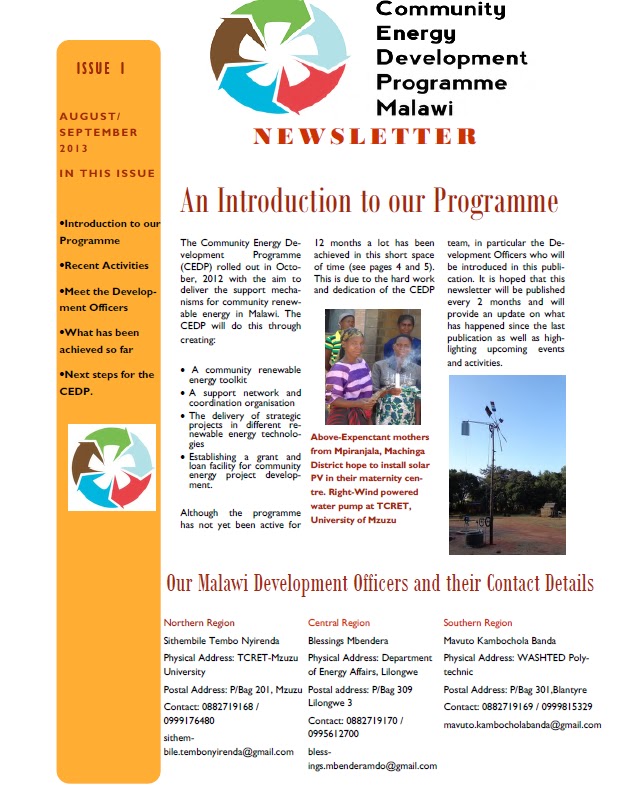
CEDP Newsletter launched!


The inaugural newsletter has been created and can be accessed on the Community Energy Scotland website here. It is hoped that this will become a bi monthly newsletter with Programme updates as well as interviews from communities involved in the Programme and notifications of upcoming events. Let us know what you would like to see in the next editions!

Sunday, 4 August 2013

The End of the Trip

Following the trip to Mzimba and Mzuzu, there have been a handful of meetings to attend before I head home today which has given me some time to think back over the past fortnight. It’s interesting that regardless of the region, all of the communities which I have visited can already visualise the improvements and development opportunities a renewable energy system can bring.

 
Baobab, Dowa district.
 
Malawi is an incredibly friendly and welcoming country that really does deserve it's name of "The Warm Heart of Africa". It’s been a great opportunity to meet with the brilliant DOs who have achieved so much in a short period of time as well as the other CEDP and MREAP partners.

It has also been fascinating to see the number of domestic scale solar installations as you travel through Malawi. It is quite common to see solar panels outside small shops offering a phone/battery charging service or selling refrigerated cold drinks. It is obvious that for those not connected to the grid, solar PV in particular offers real business opportunities for Malawians.


One of the many households I saw with small solar panels which power a light bulb.
 
It has also been interesting to hear of previous renewable energy programmes run by other organisations which have followed a model focussed on gifting a renewable energy system to a community. In these programmes there is often no community contributions, no training on system maintenance or how to develop a business plan to ensure sufficient funds to maintain the system once the NGO has left. This model is what some communities now come to expect from development programmes and it’s really exciting to see the different approach that the CEDP is taking being accepted so warmly by communities. I feel that this is testament to the hard work of the DOs.

Very few of the people that I have met over the last fortnight have wanted a renewable energy system handed to them on a plate. The next few months will see a phase of intensive training with all of the communities followed by the systems being installed in October. The Programme Manager, Georgy Davis, will be out in Malawi during this critical period and I can’t wait to see how the projects progress. From the work that the DOs have done with the communities already, plans are already being made for what will happen once the systems are installed. Watch this space for more updates!