CEDP

CEDP

Wednesday, 25 June 2014

Neno District Project Visit

 
Earlier this week Mavuto (Southern Region Development Officer) jolted and bumped his 4x4 along the hilly and dusty road to Neno District with me in the passenger seat. It was going to be the first time that Mavuto had visited Chididi Community Based Organisation (CBO) since the installation of a series of Solar Photovoltaic systems in the community funded through the CEDP.

 
Long and winding road to Neno!
 
The installations included 4 solar PV systems in school teacher's houses, solar PV in 1 school block and head teacher's office and finally 1 solar PV installation in the office of the CBO. It was so exciting to be able to see one of the projects that I have been reading about on paper for so long!


Installations on 2 of the 4 teacher's houses in Neno

 
Installation on the Head teacher's office
 
All of the systems have only been installed for a matter of weeks so it is quite early to be discussing impacts, however, when I asked the head teacher, Maxwell, what difference it had made to him having a light in his office, he said that it had made a huge impact on him being able to work late into the night with good lighting.
 
Moses Gadama from the Energy Committee also said that “we are in the light, we no longer have to travel long distances to charge phones or to get our hair cut, this can now be done in our community thanks to the electricity from the solar, these new business opportunities are exciting.”


Chididi CBO well lit by the solar PV installation in the school block


The head teacher, Maxwell, with his wife in their newly lit home. 

What I found particularly interesting during this visit was the attitude of the community. They were obviously all very interested to hear what I had to say in terms of future "donations" to the community. Whilst Mavuto has repeatedly made it clear to the community that these systems will not be supported by further donations but instead by revenue generating ideas that Mavuto has helped them to establish, since I was visiting the UK the community thought they had better double check "straight from the horses mouth" on any further funding!

Mavuto further reinforced that no further funding was available at this time and that the community should instead look to the revenue generating ideas that Mavuto is supporting them to establish. In this community these ideas include mobile phone charging and a barber shop, both of which will utilise electricity from the newly installed solar PV systems. Profits from these enterprises will go into a maintenance fund that is managed by the community Energy Committee to fund the ongoing costs of all of the systems in the community. It is hoped that any additional funds can be used to set up further revenue generating activities in the community - we're all very excited to see how this will develop!

 
Travelling back to Blantyre behind a lorry laden with charcoal to sell in Blantyre. Is it not the local use of firewood that is causing the huge deforestation in Neno District, but the huge demand for charcoal from towns that causes so many of the Neno trees to be cut down.


On closer inspection, a LOT of charcoal being transported to Blantyre. The need for fuel efficient stoves in urban areas is therefore just as big a priority as it is in the rural areas. 

Friday, 20 June 2014

Malawi's First Community Energy Conference a Huge Success!

I write this post the day after Malawi's first ever Community Energy Conference, it was an incredible day and I know that the pictures and paragraphs below will not capture the buzz that was generated at this event!
The conference was held to provide a platform to officially launch Community Energy Malawi, launch the Community Renewable Energy Toolkit for Malawi but finally (and possibly most importantly), to bring together representatives from the 12 Community Based Organisations (CBOs) that have been involved in the Community Energy Development Programme and other key stakeholders for the first energy conference of its kind in Malawi.


Packed conference venue!
 

It was an action packed day with a full programme which can be accessed here. Community Energy Malawi was honoured to be hosting a number of high profile speakers and guests including the Key Note Speaker, Director of Administration for the Ministry of Energy, Mr Maxwell Tsitsi; Mr Raphael Kamoto, the CEO of Malawi Energy Regulatory Authority; the Deputy Director of Energy Affairs; Community Energy Scotland staff Nicholas Gubbins (CEO) as well as Community Energy Board Members Kelvin Tembo, Yamungu Botha and Dr Arnold Juma.

 
The top table! (L-R) Edgar Bayani, National Coordinator; Kelvin Tembo, Community Energy Malawi Board Member; Deputy Director of Energy Affairs, Joseph Kalowekamo; Maxwell Tsitsi and Nicholas Gubbins

It was noted by many of the speakers and attendees that all of the honoured guests were taking lots of notes and they were all still present when the closing remarks of the conference were being delivered. It is testament to the quality of the presentations and discussion that the attention of so many of the "movers and shakers" in the energy industry was maintained for the whole day!

This conference was also about giving community groups the opportunity to present their projects, share their experiences and ask questions directly to senior figures in the sector. This is the first time that community members in Malawi have had such a platform to do this and several members of the community took this opportunity to ask thought provoking questions to the speakers.


Lloyd Chiwaya, a community member from Balaka who was presenting his experiences of community energy projects installed by Concern Universal.


Mr Hevvens Theu from Fwasani CBO giving a fantastic summary of the projects involved under the CEDP.
 

Central Region Development Officer - Blessings Mbendera said "It was so great to see the intra-community group networking, group members from Balaka (in the Central region) speaking with groups members from Chitipa (in the Northern region), it was a very special day". And as Sithembile, Northern Region Development Officer noted, "it is so often the case in Malawi that we hold discussions about the community in their absence, it is a great thing that the community is here today with us to be involved in the discussions".


Sithembile, Development Officer for the Northern Region and our Director of Ceremonies

And of course there was the unveiling of Community Energy Malawi (CEM) by our National Coordinator, Edgar Bayani, the Board Chair for CEM, Kelvin Bayani and our guest of honour, Maxwell Tsitsi. There was much applause and many of the community groups and assembled stakeholders have already pledged their wish to become members of CEM and contribute what they can to make the organisation a success.

 
The official unveiling and launch of Community Energy Malawi!

The launch of the toolkit was also a great success with the majority of the published material being distributed to the community groups and key stakeholders by the end of the conference. The material will all be uploaded to the Community Energy Malawi website and a note will be put on this blog when this process is complete.

 
Community members from Dowa District being interviewed by the national press. Watch this space for how CEM hits the headlines!

Perhaps one of the most thought provoking presentations was given by Dr Arnold Juma, a lecturer at Mzuni University in Mzuzu, in the Northern Region. Dr Juma carried out a PhD into what makes a Solar PV system sustainable in rural Malawi. His findings were very interesting with the key points being that it is possible for rural PV systems to be sustainable but that the systems should be decentralised systems and that the strategy for installation should be based on "selling" as opposed to "donating" the technologies on part of the project sponsors and "buying" as opposed to "receiving" on the part of the beneficiaries.

All of the presentations from the conference will be uploaded to the Community Energy Malawi website in the next few weeks.

Packed Conference Venue!


Blessings looking at some of the exhibitors at the conference
 

And finally the day was rounded off with traditional dances from the Gule Wamkulu - traditional dancers dressed in amazing costumes who entertained the attendees on the lawns outside the conference venue. As Yamungu Botha, a member of the CEM board commented, the inclusion of the communities at every stage of this conference 'really added value to the word "Community" in Community Energy Malawi', with such a positive unveiling, we are all really excited to see where this momentum will lead.


Example of the Gule Wamkulu

Monday, 16 June 2014

CEDP Team Meeting at Salima


I write this blog post having just got back from a CEDP team meeting at Salima, a town on the shores of the beautiful Lake Malawi. Since the CEDP team are spread out over the whole of Malawi it was the first time since the end of March that the whole team has got together, and what a fantastic setting for a team meeting!
                          

CEDP Team striking a pose at Lake Malawi (L-R) Blessings, Mavuto, Sithembile and Edgar
 
The last few months have seen an incredible amount of effort and activity from the DOs and Edgar. The DOs have been helping groups to install projects now that funding has been approved and Edgar has been very busy organising Malawi's first Community Energy Conference as well as setting up Community Energy Malawi (CEM), the organisation that will take on the activities of the CEDP and enable communities in Malawi to create sustainable renewable energy solutions to meet their energy needs. 
 
This team meeting was focussed on clarifying budgets and activities for this year as well as starting to think about potential future partnerships and collaborations for Community Energy Malawi and, of course, readying everybody for this weeks' conference!


Women carrying firewood home on the shores of Lake Malawi. Each of these large bundles will only last a household 3 days at most.
 
Following the team meeting Community Energy Scotland CEO, Nicholas Gubbins, travelled to the North of Malawi with Sithembile to see some project installations there. Sarah and Edgar are busy in Lilongwe preparing for the conference which will take place this Thursday, the 19th June. 

Sun setting at Salima, Malawi
 
Looking forward to being able to put up the next post which will include lots of photos and summaries of key discussions held at the conference!

Tuesday, 10 June 2014

Community Energy Scotland Staff Head to Malawi Ahead of Conference

Today, Sarah Jones, International Development Officer for Community Energy Scotland, left Scotland for Malawi ahead of Malawi's first Community Energy Conference set to be held in Lilongwe next week on the 19th June in Lilongwe. Chief Executive of Community Energy Scotland, Nicholas Gubbins, will also be travelling out to Malawi later this week to attend the conference and visit some of the projects that have been funded and installed under the Community Energy Development Programme. Sarah and Nicholas will be taking photos and posting articles throughout their trips to Malawi so watch this space for updates!

Sarah Jones - excited about next weeks' conference!

Monday, 2 June 2014

Fourth CEDP Newsletter Published!

The 4th CEDP newsletter has been published covering activities from February 2014 - April 2014! To view the newsletter, visit the Community Energy Malawi website by clicking here.

Friday, 2 May 2014

Vacancy with Community Energy Malawi!

Funding has been approved by the Scottish Government for the CEDP for the financial year 2014 - 2015. As part of this funding, the development and consolidation of a membership based, national organisation to take forward the community energy agenda has been identified as a key priority. This fledgling organisation has the working name Community Energy Malawi (CEM) and it's main aim is to enable communities in Malawi to create sustainable renewable energy solutions to meet their energy needs.

CEM will be officially launched at our Communiet Energy Conference on the 19th June 2014 (see post below) and as part of the development of this new organisation, CEM is looking to recruit a Finance, Administration and Communications Officer to start in June 2014.


For full information on the job and to download an application form, please visit the CEDP website here.

Thursday, 1 May 2014

Community Energy Conference in Malawi Announced!

We are delighted to announce that Malawi's first Community Energy Conference will be held in Lilongwe on the 19th June 2014. The event will see the launch of Community Energy Malawi as well as the launch of the Community Renewable Energy Toolkit for Malawi developed under CEM. There is more information on the conference in the flyer below.


 If you are interested in booking a place on the conference, please contact Edgar Bayani, the CEM National Coordinator on edgarkbayani@gmail.com. Watch this space for more news on the conference!

Tuesday, 8 April 2014

Over 40 CEDP Projects Approved!

In truth I am not sure where the time has gone since we last posted! But that is testament to the huge amount of work that the CEDP have been doing to make sure that activities were completed by the end of March 2014.

Each Development Officer has been working hard with the 4 community based organisations (CBO) in their respective regions (see our newsletters here for updates on the DOs activities). Having identified the main needs in each community, supported the community to find an appropriate renewable energy solution to address this need and through providing appropriate training and capacity building it is hoped that all communities are now well prepared to operate and manage the systems themselves. As such, at the end of March, each CBO was ready to submit an application for funding to build the renewable energy projects that will address the need in their communities.

We are delighted to announce that each of the 12 CBOs has successfully submitted applications for funding with 43 projects being approved for funding by the 31st March. The different types of and numbers of installations are outlined below:

North Central South Total
Solar Powered Water Pumping 1 0 1 2
PV for CBO office 2 0 0 2
PV for Primary School and staff houses 12 4 4 20
PV for CDSS 3 0 1 4
PV Teacher Development Training Centre 1 0 0 1
Cook stoves 2 2 0 4
Solar lanterns 1 4 4 9
PV for  Health Centre, fridge for medical supplies and staff houses 0 0 1 1
Total projects installed 22 10 11 43

Each DO is now working with each of the CBOs to make sure that projects are installed, watch this space for installation news!

Wednesday, 19 February 2014

Third Issue of Newsletter Released!

The CEDP newsletter covering programme activities in December 2013 and January 2014 has now been released! To access the newsletter visit the CEDP website by clicking here

http://www.communityenergymalawi.org/#!media/c1mhy

Tuesday, 18 February 2014

Sarah Jones visits Martin Ketembo to Work on Toolkit

At the end of January 2014, Sarah Jones visited Malawi for a 2 week period to work closely with Martin Ketembo of Mulanje Renewable Energy Agency (MuREA) on the Community Energy Toolkit for Malawi.


The MuREA office with the Mulanje Massif in the background

During this visit Sarah and Martin received all of the contributions for the toolkit, were able to edit the contributions into a first draft of the toolkit and circulate the draft to stakeholders and partners for comment.

The current format of the toolkit is as follows:

The Primary Toolkit
- An A4 booklet which will be a "one stop shop" for development workers and community members with higher literacy levels

The Secondary Toolkit
- An A5 booklet with key information on how to maintain, repair and troubleshoot issues for each of the technologies contained in the primary toolkit.
- A series of A4 illustrations depicting key messages from the primary toolkit. These can be used as a visual aid by development workers who are working with communities with lower literacy levels.

Of her recent trip to Malawi Sarah said:

 "I was based in the MuREA office in Mulanje which is in a truly spectacular part of Malawi. Being able to work in the same office as Martin has made coordinating this important stage of the toolkit a lot simpler. I've been made to feel so welcome by all of the staff in the MuREA office and I look forward to being able to come back soon, next time I will make sure I leave enough time to explore Mulanje Mountain on my days off!"

As soon as the toolkit is available we will upload a copy to the CEDP website - www.communityenergymalawi.org Watch this space!

Monday, 13 January 2014

CEDP Hits the Headlines!

Last week, an article on the work of the CEDP and it's importance in the cook stove projects in helping to fight deforestation in Malawi was published in The National Times - one of the main newspapers in Malawi.

Blessings Mbendera carrying out cook stove awareness training, Lilongwe District


Central Region Development Officer, Blessings Mbendera, gave a great overview of the programme as well as the programme partners. You can view the article from this news piece on the CES website.

Wednesday, 18 December 2013

CEDP website live!

The CEDP now has a website! To access the website visit www.communityenergymalawi.org or follow this link here


Positive impact already seen at Machinga!

Mavuto, the Development Officer for the Southern Region recently gave an update on the project progress for Umodzi CBO, Machinga District.

Umodzi CBO are planning to install solar PV panels in their community schools and word has spread about this upcoming development to the surrounding communities. So much so that the school register has increased from approximately 900 pupils to over 1700 in anticipation of the solar PV installation!! When asked about why this was, Mavuto said that people in the surrounding community were keen to go to a school which had electricity as they could study in the evenings.


One of the school buildings in Machinga District where Solar PV will be installed under the CEDP.


It's really exciting to hear this type of news from the field. The project is not yet installed and already we can see the potential positive impacts that the CEDP projects may have. Stay tuned for more news from the field!

Wednesday, 4 December 2013

New Blog from University of Strathclyde

Over the last two weeks 3 members of staff from the University of Strathclyde (the University of Strathclyde are the MREAP project coordinators) travelled to Malawi to catch up with the MREAP partners on project progress and outline what the on going strategy will be for MREAP.

 
(l-r) Peter, Damien and Magnus from University of Strathclyde
 

During their trip, Damien, Peter and Magnus put together a fantastic blog which outlines some of the work going on in the CEDP as well as projects being carried out by other strands of the MREAP programme. (For a refresher on MREAP and how the CEDP sits within MREAP you can visit this website.).

You can access the University of Strathclyde Energy for Development Blog here.


Building a biogas digester in Mchinji District. This project is being developed by Mzuni University in Mzuzu, one of the MREAP Strategic Partners. 

Wednesday, 13 November 2013

CEDP at Community Energy Scotland Conference!

On the 5th and 6th of November Community Energy Scotland, CES, held their annual conference in Glasgow. The topic of this year's conference was how innovative technology can link local renewable energy generation to local consumption of energy. This topic is of particular relevance for many communities in Scotland where access to the main electricity grid is not possible due to constraints or expensive grid upgrades being necessary.

For many communities in Malawi, looking at off-grid solutions for their energy needs is also common since the national grid only services 9% of the population of Malawi. In this way, communities in rural Scotland have things in common with communities in Malawi. Both are looking for off-grid solutions for their energy needs.

International Development Officer, Sarah Jones, discussing the CEDP with Scottish community groups and proudly wearing her CEDP t-shirt!

A number of Scottish community groups were interested in being informed of the activities of the CEDP and were interested in developing a partnership programme between communities in Malawi and Scotland. Watch this space for more details on the partnership programme!

Tuesday, 12 November 2013

New Issue of Newsletter Published!

                                
To access the second CEDP newsletter go to the Community Energy Scotland website here.

Tuesday, 29 October 2013

CEDP's first batch of cook stoves ready for use!


On November 24th I accompanied CEDP Central Region Officer Blessings Mbendera to carry out the final part of the cook stove production training for Nzona CBO in the district of Dowa. The journey took around 2 hours from Lilongwe and on route we picked up a Social Sciences student from Chancellors College who was keen to find out more about the Community energy sector together with Janet Msiska from Area 55 Consulting who the CEDP in the Central Region has been working together with to carry out the cook stove training programme.

On arrival we were met by an incredibly enthusiastic cook stove producer group who were singing and dancing in celebration. During the day I discovered that the work involved in the production of a clay cook stove took a great deal of commitment and was overwhelmed by the eagerness of the community to make their social enterprise a success! In this blog I will describe the process of clay cook stove production used by this community from clay selection right through to firing.  


Villagers from Nzona CBO in Dowa district surrounding a clay cook stove firing chamber.


Preparing the raw materials

The first stage of cook stove production is to figure where you will get your clay from and decide where your production group will be working from. I discovered that day that extinct ant hills often provide the right quality of soil for producing the cook stoves and after clay analysis from several sites it was discovered that Nzona CBO are fortunate enough to have two sources of clay only ~200m from their production bases.  Given the demand for cook stoves both within the CBO and neighbouring areas it was decided that two production groups be set up in neighbouring villages. Fortunately both are situated close to the clay source.

Despite making it look easy I know that the harvesting of clay is not an easy job. Luckily Blessings has a Nissan pick-up which the community were able to take advantage of to transport the clay from the collection site to where the clay was to be cured. Had we not been there with a vehicle that day I am told that the community would have carried the clay in bags to the production sites.


Members of the energy committee harvesting clay for cook stove production.

In preparation of the clay arriving, a hole had been dug measuring 1m wide x 2m long x 1m deep. Black plastic sheets are then positioned as lining within the hole, the clay is added and covered on top by the sheeting. The purpose of the black plastic sheeting is to act as an impermeable layer so that any living organisms are killed off during the curing process. If this is not done the quality of the clay will be poor and the stoves are likely to crack during the firing process.

Hole being dug which will be lined with black plastic sheeting for curing process.

The process of curing takes 14 days. During the process once every three days water (40 litres approx) is added and mixed in with the clay so that by the end of the curing process the clay is malleable enough to shape into stoves.


Taking shape

Some groups shape the clay stoves by hand, however the approach this community has taken is to use a pedal mould to create standard ‘Chitetezo’ stoves (Chitetezo in Chichewa means Protection). The uptake and roll out of Chitetezo stoves is also being encouraged by the Government of Malawi and the cost of a pedal mould is in the region of 50,000 MK (£100).

A pedal mould for making Chitetezo stoves. The mould comprises of three separate parts, base, cup and pedal.

Once the general shape of the stove has been moulded it its taken out of the mould and a hole is cut at the base which will allow an entry point for fuel. The holes are purposefully kept on the smaller side to encourage use of smaller branches rather than tree trunks, thereby reducing number of trees felled.

Handles are also added manually to the side of the stoves together with three sections on top which allows for pots of different sizes to be used. Small tools made from pieces of wood are used at this stage to ensure even sizing and positioning attachments to the pots. Every pot also has a unique code engraved on it so that a buyer knows where the pot came from. Often the creator adds their name to the base along with their own unique artistic flare - many stoves had patterns engraved around the edge.


One of the first cook stoves produced by Nzona CBO as part of CEDP training.

Once moulded the pots are put in shelter, protected from wind and direct sunlight to partially dry for 1 to 2 weeks. Unfortunately as the group do not yet have a purpose built shelter (this will be funded from the CEDP capital grant once approved) they had to use the tobacco drying sheds which do not have adequate protection from the wind and as a result some of the stoves cracked.

Me with the Dowa cook stove production group in the temporary drying shelter.

Firing the stoves

The stoves that were still intact were then placed in the firing chamber which had been built especially for this purpose. Sizes of firing chambers vary, however the one that were deemed suitable for Nzona CBO were approx 2m in diameter, 1 meter high and took around 5000 bricks to build (half of which were supplied by community contributions). Apparently each chamber is able to hold up to 120 stoves per firing session and there is one at each cook stove producer group.

Before building the structure a hole is dug and a foundation made which comprises a mix of sand and quarry stones (1 wheelbarrow full each, also supplied by the community as part of their contributions towards the project). The main purpose of the foundation is to provide a drainage system for the chamber during the rainy season however it also has the additional benefit of acting as a heat store during the firing process.

The structure is made with openings and channels for wood to be inserted at the base of the chamber. The stoves are stacked on top of one another within the chamber, the top sealed with grass and mud, and only then is the wood added and lit. For a chamber of this size I am told that 1 ton of small branches are required (equal to approx 1 ox cart full). The actual burning of wood takes 6 – 7 hours and you leave the chamber for a day or two until the temperature of the stoves have cooled enough to enable handling.

Inside of the cook stove firing chamber

All that was left to do was take the stoves out from the chamber and start using them.

The first batch that were taken out from the chamber the day I arrived had been produced during the training period and were considered to be a ‘test batch’. These stoves will be dispersed among the cook stove producer group and before the next batch is ready the producer group together with the energy committee have some work to do on their business plan to determine how the stoves will be marketed and sold and at what price.

The retail price of cook stoves such as these within towns and cities in Malawi is currently 1000 Malawi Kwatcha (approx £2). I am told that the producers are unlikely to get more than 500MK per stove produced, however the good news is that demand currently far outweighs supply and so provided they can continue to produce them and have a sound marketing strategy they can continue to sell. The hope is that once all the CBO members have adopted the technology the CBO can work with marketers such as Area 55 consulting who supply retailers and towns and cities. 

I was fortunate enough to buy one of the stoves from the first batch from them... I just hope it makes it through customs!

Monday, 7 October 2013

Georgy Davis arrives in Malawi!


CEDP Programme Manager Georgy Davis has finally arrived in Malawi having battled through lengthy flight delays to get there.

Georgy will spend 6 weeks in Malawi catching up with CEDP Development Officers, the Strategic Energy Partners and other CEDP staff. This is a particularly important time for the CEDP as the 12 Community Based Organisations (CBOs) which the CEDP has been working with are finalising project designs and applications for capital funding will soon be submitted.

Georgy's visit will also give her the opportunity to meet with Edgar Bayani who is setting up and registering a community energy organisation in Malawi and with Martin Ketembo who is developing a community renewable energy toolkit for Malawi. Both pieces of work are vital in ensuring that the wider support network and resources necessary to support community energy in Malawi are in place. Watch this space for updates from Georgy!

Friday, 6 September 2013

Edgar Bayani - Development Coordinator in post!

This has been a very exciting week for the CEDP as the new Community Energy Malawi (working name) Development Coordinator started work on Monday 2nd September. Discussions with Strategic Energy Partners (SEPs) in Malawi had revealed that there was a real need to create a new, independent, nationally based organisation whose remit was to drive the Development of the Community Energy sector in Malawi. This is considered crucial in ensuring continuity for the Programme after March 2014. Edgar's principal role will be to set up and register the organisation which will take forward Community Energy in Malawi.


On starting his new role Edgar said:

'Giving ordinary Malawians a chance to influence policy and have better energy sources is a task for us all but it’s an honour to be tasked with setting foundations for CEM as a means of providing Malawian Communities that chance. Providing sustainable energy solutions is a MUST for Malawi. It is a challenge I am prepared to take with passion because as Donald Trump Said, “without passion, you don’t have energy and without energy, you simply have nothing”'.

We're all really excited to have Edgar on board, welcome to the team!

Friday, 23 August 2013

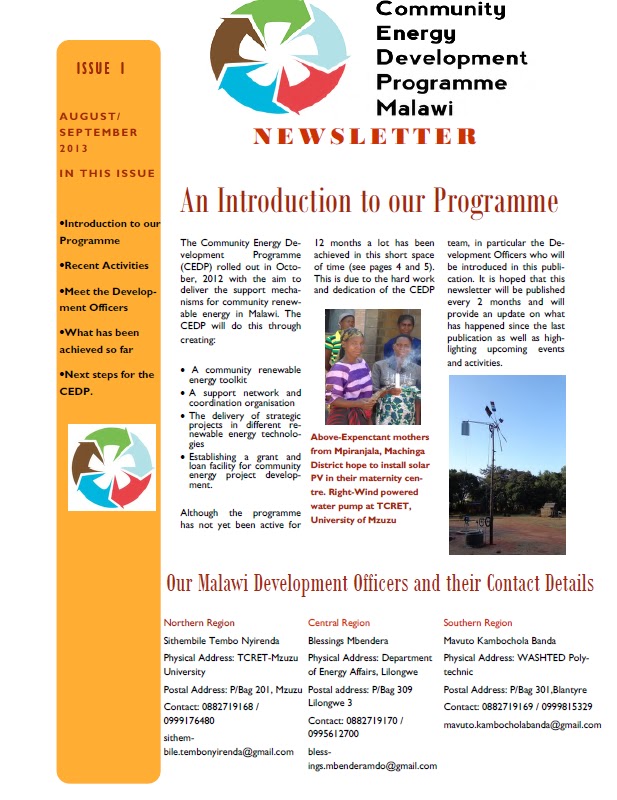
CEDP Newsletter launched!


The inaugural newsletter has been created and can be accessed on the Community Energy Scotland website here. It is hoped that this will become a bi monthly newsletter with Programme updates as well as interviews from communities involved in the Programme and notifications of upcoming events. Let us know what you would like to see in the next editions!